Hopped Up
Charleston’s craft beer industry continues to grow, with breweries consistently opening, and old standbys like Palmetto and Holy City Brewing expanding operations. In fact, the industry that accounts for $905 million in economic impact is affecting all levels of the state’s three-tier system, as breweries, distributors and retail shops small and large try to get a sip from the growing growler.
Today, the tri-county area counts 36 breweries, according to South Carolina Brewers Guild executive director Brook Bristow.
“If we go back to 2011, that was the year Westbrook and Holy City opened,” he said. “Before them, all we had were Coast and Palmetto.”
The last decade’s growth is due in part to changes in state law that enabled breweries to sell and brew more beer. Perhaps the biggest shift came in 2017 when it became legal for brewpubs like Edmund’s Oast to distribute through wholesalers, a change that has helped newcomers grow fast.
“Based on our run rate this year, we’re going to sell 6% out of our taproom — everything else is out the door,” said Edmund’s Oast operations director Timmons Pettigrew, referring to the group’s King Street Extension brewery, which opened in 2017. “Our physical footprint here in the facility is large, so we always knew that distribution would have to be a huge part of the puzzle.”

The 2017 shift allowed local brewpubs — places with a permanent food service provider — to utilize the three-tier system. Essentially, Edmund’s Oast, for instance, must sell its beer to a wholesaler, who distributes it to retail shops for sale to consumers.
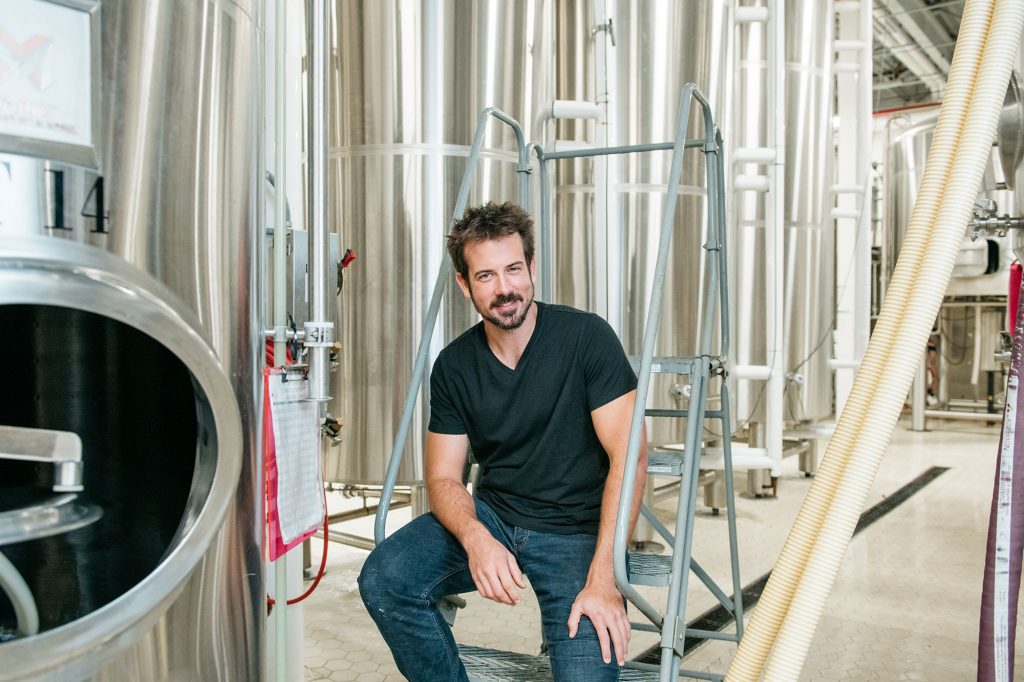
According to Pettigrew and brewing director Cameron Read, Edmund’s Oast Brewing Co. has brewed over 100 beers since opening in 2017, and it now distributes in eight states. Producing 90 barrels of fruited sours each week — amounting to about 29,760 12-ounce cans — beers in this category are currently Edmund’s Oast Brewing Co.’s top seller.
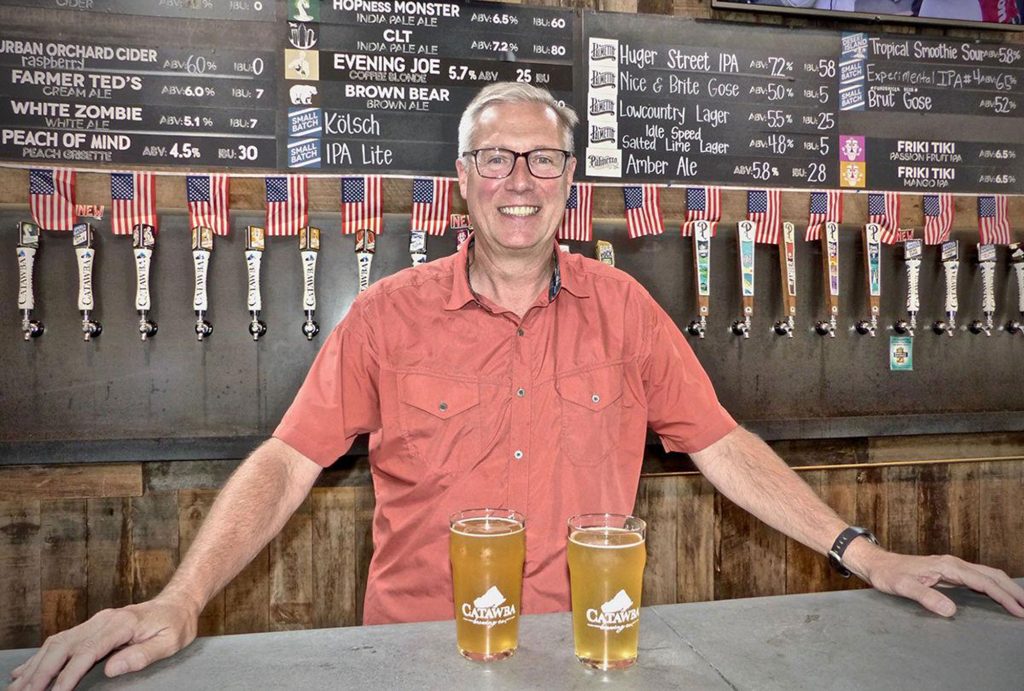
As a whole, the industry’s impact is up 28% from $650 million in 2017, and while 2020 was a down year for most independent breweries, the state is becoming an attractive investment opportunity for bigger brewers looking to focus on wholesale distribution. In November 2020, Mark Anthony Brewing — producer of White Claw Hard Seltzer — announced a $400 million investment to build a production facility in Richland County. Locally, the area’s oldest independent brewery got an infusion of outside cash from North Carolina-based Catawba Brewing Co., which purchased Palmetto in 2017.
Catawba co-owner Billy Pyatt said the company “immediately put $1 million of equipment in” for a new brewhouse and tanks, with another $500,000 spent on a new canning line during the pandemic.
“Today, there’s much more beer being made in that building than was ever before,” Pyatt said. “We’ve become a real integral part of [the distributors’] business plan.”
Middle men
The local craft beer industry’s growth is being fueled by distribution, which makes sense, given only a limited number of people can stop by a single brewery taproom on a given day.
For small wholesalers which handle distribution, it’s an uphill battle to compete with bigger operations deeply ingrained in the market. But, Low Country Craft Distribution co-founder Greg Montieth told the City Paper there’s more market share now than in 2016 when the company opened with two breweries.
“It was a lot of cold-calling at first, but we started having breweries reach out to us,” he said. “A big turning point for us was during the pandemic last year.”
The shift occurred when Advintage Distributing, one of what Montieth described as “the big three” distributors, purchased Low Country Craft’s main competitor. The other two widely known Southeast distributors, Southern Eagle Distributing and Lee Distributors, combine to represent a mix of smaller craft breweries like Palmetto and Commonhouse Aleworks as well as Anheuser-Busch, Molson Coors and other domestic and international conglomerates.
State Sen. Sean Bennett of Summerville, who sponsored two 2017 bills that made it legal for breweries to sell liquor and participate in nonprofit events, says the power of those multinational brands can be felt within the S.C. market due to the three-tier system.
“The distributors themselves get a lot of push from the big manufacturers that almost treat the distributors like the distributors sometimes treat small brewers,” said Bennett, recognizing that the three-tier system is something the state is committed to for the foreseeable future. “We have distributors that have invested hundreds of millions of dollars over the years, and I recognize that it is an important piece of the economy.”
Low Country Craft now services 30-plus breweries, most of which are the small businesses in danger of getting swallowed up by the three-tier system.
“The demand is incredible. We had an explosion in breweries that we represent,” Montieth said, describing why smaller breweries turn to Low Country Craft. “Sometimes they get lost in the shuffle, just because they’re such an insignificant part of their overall business.”
Southern Eagle and Crown Beverages merged in 2018 to form Southern Crown Partners, a company that distributes an average of 47,000 cases daily in South Carolina and Georgia. Southern Eagle is one of Anheuser-Busch’s oldest continual distributors in the country, a profitable partnership that helps fund other divisions of the company, craft brands director Matt Galentine told the City Paper.
The wholesaler represents five craft breweries in Charleston, and Galentine’s division is broken into three groups: on-premises (bars/restaurants), grocery stores and convenience stores. When it comes to finding space for products at big box grocery stores, Galentine says it’s their job “to get all this beer out there, and then the customer makes the decision on what they want to purchase.”
“Retailers are open to making room on the shelf. [Product placement] is decided at more of a corporate level within the chain, and then when they do that, that’s typically set for a year,” he said.

For smaller retail shops like Park Circle’s Brew Cellar, the increase in breweries has led to more variety, allowing co-owner Ryan Hendrick to better serve regular customers.
“There are a lot more options now, that’s for sure. The odd thing is we’ve gone to mostly seasonal stuff from the local breweries because they’re out there a lot more,” he said. “We can’t compete, necessarily, with grocery store pricing, so we specialize in rotating seasonals.”
Each week, Hendrick receives emails from distributors “listing what is interesting.” Bigger breweries have representatives, but others do not, so Hendrick stays up to date by checking social media.
“We tend to jump at whatever their newest releases are because those are more readily available than they were seven years ago,” Hendrick said. “It makes it more interesting for a shop like us that has repeat customers.”
Trickle-down?
Well-established businesses with deep pockets stand to gain from the craft beer industry’s growth, but what about small breweries in the area?
Indigo Reef Brewing Company was relying on taproom sales at the start of 2020, but that all changed after the pandemic. After closing for 61 days, owners Chris and Nicole Ranere talked to their distributor, Low Country Craft, to arrange for a mobile canning line to come to the brewery to help sell more beer through distribution.
“We worked with them to get those cans out, and it really worked well,” Chris Ranere said. “We found that it worked so well that we did it again, so we actually looked at canning lines of our own.”
When the couple opened Indigo Reef in June 2019, a canning line was in their three-year plan, Chris Ranere said, but a Small Business Association loan helped them purchase one just before their first
anniversary in 2020.
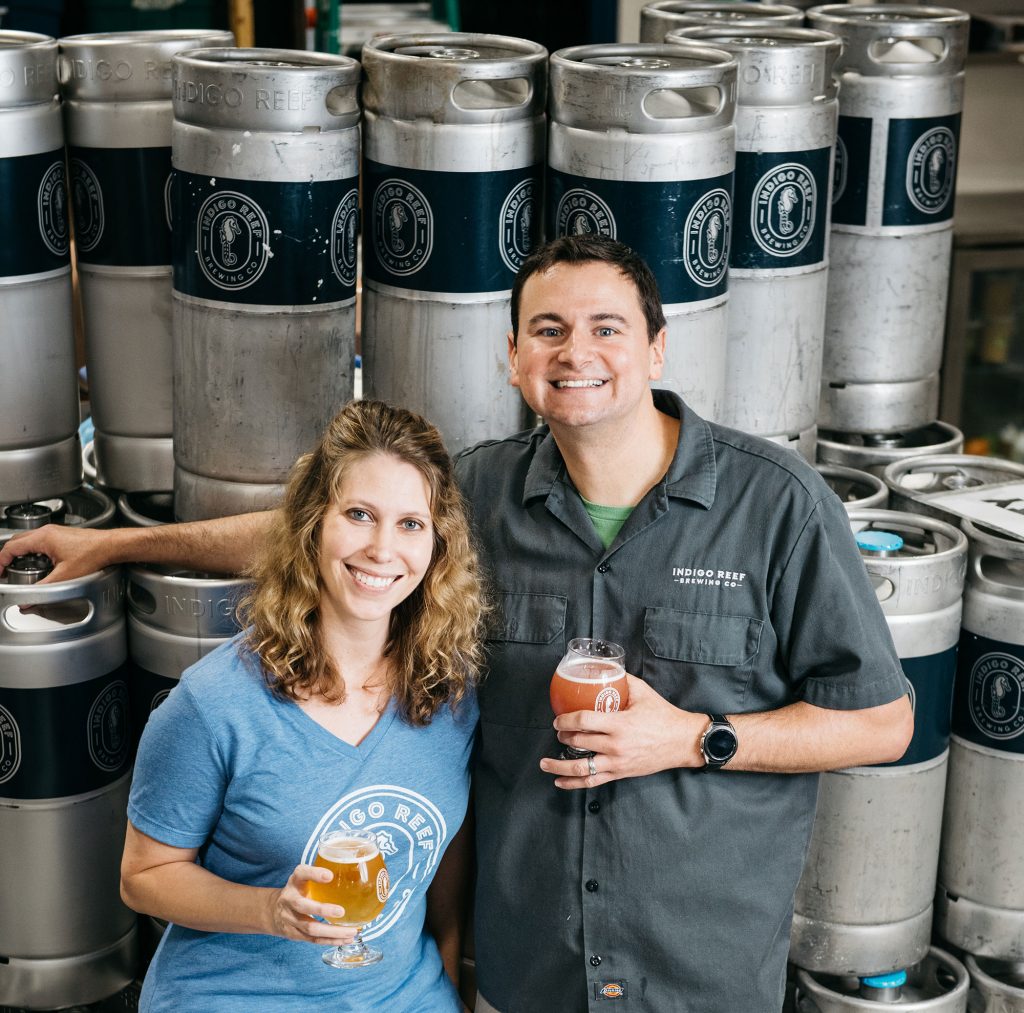
Looking back to February 2020, Indigo Reef had $4,469 in sales from distribution — that number dipped to just $450 in April due to bar and restaurant closures. But once they added the canning line, the Raneres started to notice a shift. In March 2021, Indigo Reef made $12,500 from distribution, which now accounts for about 50% of sales, Chris Ranere said.
But taproom sales are still key for small breweries like Charles Towne Fermentory, where 70% of the sales take place on-premises, founder Adam Goodwin said. Fermentory can produce between 120-130 barrels in a given month, about a third of what Edmund’s Oast produces over the same period in sours alone.
“Selling it direct-to-consumer helps us handle the increase in cost of producing beer right,” Goodwin said. “We obviously have a small space, so we’re limited on what we can actually produce here. That limitation for volume production creates more of a situation where we want to create this space so we’re attractive to the community.”
Goodwin would like to see some legislative changes to give small breweries more control over sales and distribution.
“As soon as a brewery sells the beer to the wholesaler, it becomes the property of the wholesaler, and at that point, we don’t have a whole lot of influence on where it goes,” Goodwin said. “I think if you create laws that are beneficial for small breweries, you’re going to make the state more attractive for out-of-market brands.”
Fermentory’s West Ashley neighbor Frothy Beard Brewing Company is opening a second location in Bennett’s Summerville district, but the three-tier system means it must use a distributor to transfer beer between locations, Bennett said. While the senator views distributors as essential parts of the industry, he thinks some small changes are in order.
“I look at it from a small business standpoint — the small business guys are the ones hindered by the distributors,” he said. “The problem is every time you try to do those small incremental things, it’s perceived by the distributors as your ultimate goal is to destroy their livelihood, and that’s not the case.”

Help keep the City Paper free.
No paywalls.
No subscription cost.
Free delivery at 800 locations.
Help support independent journalism by donating today.