- BIG STORY: Nurdles still a giant problem for S.C., activists say
- ROUNDUP: Lawmakers kick earmarks down road to get budget deal
- LOWCOUNTRY, Ariail: Palmetto rumble
- BRACK: Flying in America isn’t pleasant these days
- MYSTERY PHOTO: Boardwalk
- FEEDBACK: Send us your thoughts
Nurdles still a giant problem for S.C., activists say
By Jack O’Toole, Statehouse bureau | Imagine you’re counting tiny plastic pellets at the rate of one per second. One… Two… Three…
Now, imagine keeping that up, without so much as a coffee break, for the next 316,881 years — or about as long as human beings have walked the Earth.
Congratulations. You just counted the 10 trillion microplastic pellets, or nurdles as they’re sometimes called, that are dumped into the world’s oceans and waterways every year, according to research by the Pew Charitable Trusts.

And while no one can say with certainty how many of those pellets first find their way into the water here in South Carolina, testing indicates that the number is significant. Think millions, not thousands, experts told the City Paper this week.
In April of last year, for instance, a single Columbia-area volunteer was able to collect 4,940 nurdles in just 10 minutes at one location along the shoreline of the Congaree River.
Meanwhile in Charleston, volunteers routinely collect hundreds of pellets from sites on the Cooper River using the same process, according to Charleston Waterkeeper Andrew Wunderley.
“You just get down on your hands and knees and collect as many as you can in 10 minutes, which allows you to compare nurdle density site to site,” Wunderley said. “That’s how we were able to determine that the Cooper River is a hotspot versus other areas in the estuary.”
It’s findings like those that led Wunderley and his Columbia-area counterpart, Congaree Riverkeeper Bill Stangler, to begin moving forward this summer with separate legal actions against the companies they say are responsible for the nurdles pouring into the Cooper and Congaree rivers.
“I shouldn’t be able to go to a sandbar and pick up thousands and thousands of plastic pellets next to a designated wilderness area because some company decided it didn’t want to be responsible,” Stangler told the City Paper. “We filed this federal lawsuit to tell them ‘You can’t do this — and we’re going to hold you accountable.’”
Tiny pellets, big problems
About the size of a small lentil, nurdles are manufactured and shipped around the world to manufacturers who melt them to create the plastic products we use every day — water bottles, toothbrushes, lawn chairs, home electronics, car parts and all the rest.

All told, industry experts say that adds up to about 60 billion pounds of nurdles produced annually in the U.S. alone. And because they’re so small, all it takes is a gentle breeze — and a bit of human carelessness — to move them from factory floors and shipping stations to the surrounding land and waterways.
That’s how 10 trillion plastic pellets a year wind up in the ocean, where scientists say they pose a serious threat to marine wildlife — and the food chain that ends at South Carolinians’ dinner tables.
Why? Because once they’re in the water, nurdles act like sponges, absorbing the toxic chemicals like mercury and pesticides around them. And because they look like food, fish eat them.
Then we eat the fish.
“These microplastic pellets are a serious threat to human health,” said Carl Brzorad, the Southern Environmental Law Center (SELC) attorney who’s representing the Charleston and Congaree waterkeepers. “They get into wildlife, they get into fish, and ultimately, they get into people.”
He added, “And we know that someone is spilling large numbers of these pellets because we keep finding them immediately downstream in staggering numbers.”
‘Only a tiny fraction’ of the total microplastic problem?
Filed June 18 in Orangeburg, the Congaree lawsuit is an enforcement action under the federal Clean Water Act and the Resource Conservation and Recovery Act, which allow citizens to sue if federal and state regulators aren’t addressing known violations.
The suit alleges that Alpek Polyester USA and the Eastman
Chemical Company, which it says “co-operate” a nurdle production plant in Gaston, S.C., have “released large numbers of microplastic pellets onto the lands and waters surrounding the Plant and extending at least 26 miles downstream.”
In a July 21 statement, Alpek said it “remains fully committed to environmental compliance,” and noted that a recent S.C. Department of Environmental Services inspection “found no issues of non-compliance.”
On the same day, an Eastman spokesperson said the company “take[s] seriously the allegations made by Southern Environmental Law Center,” while stressing that it owns only a “a limited portion of the manufacturing equipment” at the site, which it says is otherwise owned and operated “in its entirety by Alpek.”
Nevertheless, the lawsuit states that the Congaree Riverkeeper “has recovered more than 10,000 pellets around and downstream of the plant” since February 2025.
“These pellets were generally recovered in time-limited sampling events
by one to four individuals,” the suit continues, “and reflect only a tiny fraction of the total microplastic pollution that the plant has released into the environment” in and around the Congaree River and the Congaree National Park.
According to Stangler, the lawsuit was a last resort, after discussions with the companies broke down.
“We spent a year documenting the problem, building a case and trying to negotiate with the company to see if they would step up and do what’s right,” Stangler said. “But in the end, we had to start a federal lawsuit to hold them accountable.”
‘Significant harm to the Charleston Harbor’
At the same time, about 100 miles south, legal action in Charleston is still in its preliminary phase, and focuses on the other end of the nurdle problem — what happens to them when they’re shipped to plastic-products manufacturers.
In a May 28 letter, the SELC notified four entities — Agru America,
Frontier Logistics, Ray-Mont Logistics and the S.C. Ports Authority — of the Charleston Waterkeeper’s intent to sue for violations of the same federal statutes at play in the Congaree case.
“These violations stem from the ongoing discharge and release of substantial numbers of plastic pellets, known as ‘nurdles,’ into the environment,” the letter states. “This unlawful pollution is causing significant harm to the Charleston Harbor, its surrounding waterways, and to the mission and members of Charleston Waterkeeper.”
According to the letter, the Charleston Waterkeeper has recovered more than 25,000 nurdles in “close proximity” to the sites since 2021.
In a July 21 email, Agru America, which uses nurdles to produce plastic pipes at a facility on the Cooper River, said it was aware of the letter, adding “we take environmental responsibility seriously and are reviewing the notice carefully.”
Neither the logistic companies, which transfer nurdles from railcars to shipping containers at their North Charleston Terminal facilities, nor the Ports Authority, which hosts their operations, returned a request for comment by press time.
In 2021, Frontier Logistics settled an earlier Charleston Waterkeeper lawsuit for $1 million without admitting responsibility after large numbers of nurdles washed up on Sullivan’s Island.
Asked if he plans to move forward with the lawsuits after the notification period is over, Wunderley said that would depend on how many nurdles keep turning up downstream — but noted that, so far, the numbers weren’t falling.
As a result, he said, lawsuits are sometimes a necessary enforcement mechanism.
“If industry self-regulation worked, we wouldn’t find the pellets,” he said. “But we find them easily and in high numbers.”
Jack O’Toole is Statehouse bureau chief for Statehouse Report and the Charleston City Paper. Have a comment? Send to: feedback@statehousereport.com
Lawmakers kick earmarks down road to get budget deal
By Jack O’Toole, Statehouse Bureau | S.C. House and Senate negotiators reached an agreement Wednesday that they say will allow both chambers to pass this year’s $15.6 billion state budget sometime in the next two weeks. But they did it more by finessing their differences than resolving them.

State agencies have been operating at last year’s funding levels since July 1, when the fiscal year began without a budget due to the Senate’s refusal to accept $315 million in House earmarks as well as the House’s refusal to go along with the Senate’s $250 million in permanent property tax cuts for senior citizens.
Under this week’s agreement, earmarks will be stripped out of the 2026-27 budget and handed off to a House-Senate committee for further consideration between now and Sept. 30. Meanwhile, the tax cut was slashed to a one-time $80 million reduction.
Negotiators also agreed to fund a $32 million settlement of an environmental lawsuit involving Captain Sams Spit on Kiawah Island, and up to $150 million in cost overruns at the state-subsidized Scout Motors manufacturing site in Richland County.
Assuming the deal passes both chambers on schedule, additional dollars for roads and bridges, teacher and state-employee pay raises, and health and welfare programs should begin flowing in mid-August.
Speaking to reporters after the agreement was reached, lawmakers were clear-eyed about the scale of the accomplishment.
“What we’ve done today,” Beaufort Republican Sen. Tom Davis said, “is agree on what we can agree on.”
Sanford joins crowded Senate race
Former congressman and Gov. Mark Sanford on Thursday jumped into the crowded Aug. 11 GOP primary race to replace the late U.S. Sen. Lindsey Graham in this November’s general election. He called for dramatic action to reduce the country’s spiraling national debt.
“I’m running for Senate because I believe our nation is at a financial tipping point,” Sanford said in a release. “We can’t keep spending money we don’t have and expect good things to happen, and yet we’re on pace to add roughly a trillion dollars to the national debt over just the next 100 days.”
Sanford, who briefly challenged President Donald Trump for the 2020 GOP presidential nomination, joins a still-growing field that already includes Graham’s sister, Darline Graham, who was appointed last week to serve the remainder of her brother’s current term, as well as 7th District U.S. Rep. Russell Fry and former 5th District U.S. Rep. Ralph Norman.
After initially leaning toward Fry, Trump pledged his “complete and total endorsement” to Graham, who until recently served as head of the state Commission for the Blind.
Other candidates include businessmen Mark Lynch of Greenville and Sam Shepherd of Lexington, former Myrtle Beach Mayor Mark McBride and Walterboro attorney Duke Buckner. A ninth contender, North Carolina resident Clark Neilson, told The State newspaper this week he plans to establish residency in S.C. now that he’s filed for the race.
Also on Thursday, the state Republican Party announced that it will sponsor a televised Senate debate at 7 p.m. on Aug. 3, though it couldn’t yet say which candidates would participate.
“As Republicans consider who should represent us on the ballot and represent South Carolina in the U.S. Senate for the next six years, it’s critical that they have an opportunity to compare the candidates on the issues and how they communicate their ideas to the public,” S.C. GOP Chairman Drew McKissick said in a statement.
The debate will air on Gray Media TV stations across the state and on the web.
In other recent news
Details released for Graham’s memorial services in D.C. and S.C. Funeral services in Washington for Lindsey Graham, will be closed to the public, but people are invited to pay their respects during a procession and service in South Carolina.
Former S.C. representative dies. Chris Murphy, 58, a former South Carolina lawmaker from Dorchester County who served in the state House of Representatives for more than a decade, died Wednesday evening.
Two sentenced for threatening Mace. Two defendants, one from Upstate S.C. and the other from Indiana, were sentenced in separate federal court actions this week for threatening 1st District Rep. Nancy Mace.
ELECTIONS: Democrats to finalize presidential nominating calendar, led by more diverse states. Democrats are poised to lock in the party’s 2028 presidential nominating schedule on Friday, likely cementing a dramatic break from decades of tradition by keeping Iowa off the top of the calendar and elevating more racially diverse states. Either South Carolina or Nevada is expected to go first, and each state has aggressively campaigned for the coveted spot.
- S.C., Nevada kick off Democratic fight for presidential primary
- S.C. Senate Democrats request election security info from state election commission
- S.C. election officials ink deal with feds solving overseas ballots
State agency told man that FOIA records would cost $2.4 million. The state Department of Environmental Services told a man worried about chemical pollutants at a school that he would have to pay $2.4 million to see soil records.
Despite pushback, data centers are booming. Some Upstate companies are betting on them. As a growing number of communities grapple with whether to ban, deter or pause new data centers — like what is happening in Spartanburg County — and other communities look to welcome the facilities that can have considerable utility consumption, the industry continues to boom.
FEMA announces additional funding for S.C. disaster relief. The Federal Emergency Management Agency has approved more than $5.5 million in funding to support eight recovery projects in South Carolina communities affected by Hurricane Helene and other disasters.
Palmetto rumble

Award-winning cartoonist Robert Ariail has a special knack for poking a little fun in just the right way. This week, he offers an insight into all of the candidates seeking to get on the November ballot for the U.S. Senate seat formerly held by the late U.S. Sen. Lindsey Graham, R-S.C.
- Love this week’s cartoon or hate it? Did he go too far, or not far enough? Send your thoughts to feedback@statehousereport.com.
Brack: Flying in America isn’t pleasant these days
Commentary by Andy Brack | Perhaps the only industry with a bigger public relations problem than the Trump Administration is America’s airlines. These days, the sound of fingernails on a chalkboard is a little better than flying.

Just about no one of late seems to have good flying experiences. A March poll, for example, showed two-thirds of Americans thought their air travel experiences at airports and on flights were worse than the year before. Half who had flown within two months had experienced delays while 8% had to postpone and 10% had to cancel a trip.
But while 86% of American adults trusted flight teams to keep them safe, according to a 2024 poll, half of those who had flown within three months of the survey said they felt less comfortable.
So passengers frequently complain about cancellations, delays, snafus, errors, poor customer service, uncomfortable seats and more. Travelers understand trips that start with frustrating lines and security checks. But they don’t make many concessions when the experience of flying seems just plain incompetent.
Here’s a case in point for a recent two-flight trip to Charleston from California with a connecting flight in Dallas. American Airlines flight 2334 was to depart at 12:43 p.m. to arrive in Dallas at 5:50 p.m. with a connection to take off at 7:17 p.m., arriving in Charleston at 10:55 p.m. This didn’t happen:
- Delayed to depart from California at 1:27 p.m. “due to air traffic control management in Dallas.” New arrival time: 6:35 p.m. – just in time to make the connection to Charleston. After takeoff, however, a storm forced the jet to circle and eventually reroute to San Antonio for fuel, which caused more delays. Fortunately, other connections were delayed, meaning there was a chance to connect for Charleston.
- Departure from San Antonio was 8:30 p.m, with arrival at 9:54 p.m., more than two hours after the original Charleston connection was to depart.
- Delayed in San Antonio to 8:45 p.m. The plane eventually got to Dallas around 10:45 p.m.
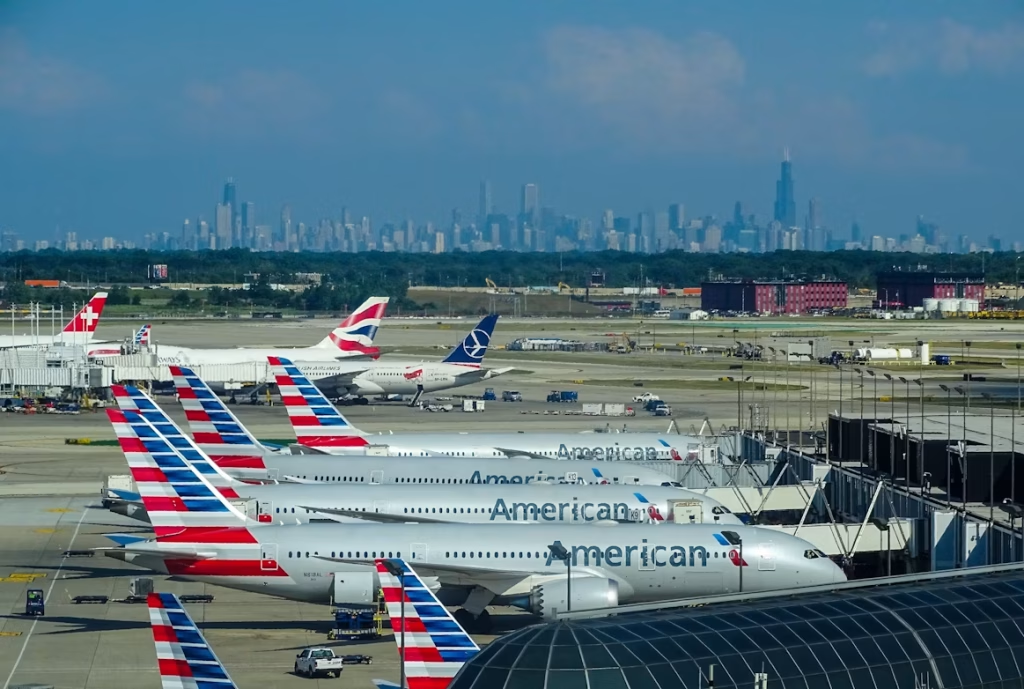
The Charleston connection was first put back to 9:30 p.m. due to “air traffic control management that affected a plane assigned to your flight.” But the comedy of errors continued:
- Delayed to 10:08 p.m.
- Delayed to 11 p.m.
- Delayed to 11:45 p.m. At least there was a chance to make this connection.
- Delayed to 12:05 a.m. About this time, we learned the plane’s pilots weren’t yet on the jet.
- Delayed 1:30 a.m. The pilots were there, but the flight attendants weren’t.
- Delayed to 5 a.m. “as your flight crew needs more time to prepare for takeoff.” Translation: the delay was due to the piloting team timing out on being able to fly. Next: a couple of catnaps on the floor of gate D40 in the Dallas airport. Spicy.
- Delayed to 5:30 a.m. due to weather conditions in Dallas.
- Delayed to 5:45 a.m. Sometime after boarding, the pilot announced that fuel was unbalanced, forcing a delay while it got balanced.
- Delayed to 6 a.m. due to “ongoing weather conditions.
- Delayed to 6:15 a.m.
- Delayed to 6:30 a.m. About this time, another team had to be called to get the gate unstuck from the jet.
- Delayed to depart at 6:50 a.m. “as we need extra time to prepare your plane for takeoff.” To arrive at 10:44 a.m.
The jet finally arrived around 10:30 a.m. – almost 12 hours after it was supposed to get to Charleston.
Lessons learned: Don’t fly through Dallas again, particularly in the summer. Leave earlier. But with the way things are, it’s unclear if that would even work.
Andy Brack is editor and publisher of Statehouse Report and the Charleston City Paper. Have a comment? Send to: feedback@statehousereport.com.
Andy Brack is editor and publisher of Statehouse Report and the Charleston City Paper. Have a comment? Send to: feedback@statehousereport.com.
Boardwalk

Here’s a different kind of boardwalk. Where is it? For bonus points, tell us why this area might be of interest now. Please send in your best guess – and your name and hometown – to feedback@statehousereport.com. And if you have a mystery photo to share, send that along too (but tell us what it is because we’re horrible guessers.)
Last week’s mystery, “Big box,” shows the tomb of the late U.S. Sen. and Vice President John C. Calhoun in Charleston.

Writes sleuth George Graf of Palmyra, Va., who shared an oddity about the burial: “John C. Calhoun is buried at the historic St. Philip’s Episcopal Church Cemetery located at 142 Church Street in Charleston. … Calhoun, who was born in Abbeville, was buried at St. Philip’s in 1850, despite the fact that he was a Calvinist who attended the Huguenot Church when in Charleston.”
Others who correctly identified what proved to be a tough mystery were Frank Bouknight of Summerville, Allan Peel of San Antonio, Texas; and Jay Altman of Columbia.
- SHARE: If you have a Mystery Photo to share, please send it to us – and make sure you tell us what it is!
Send us your thoughts
Please send us your thoughts about politics and policy in South Carolina, but make sure to leave phone numbers and hometowns to help us verify them for publication. We publish non-defamatory comments, but unless you provide your contact information – name and hometown, plus a phone number used only by us for verification – we can’t publish your views.
- Have a comment? Send your letters or comments to: feedback@statehousereport.com. Make sure to provide your contact details (name, hometown and phone number for verification. Letters are limited to 150 words.
Statehouse Report, founded in 2001 as a weekly legislative forecast that informs readers about what is going to happen in South Carolina politics and policy, is provided by email to you at no charge every Friday.
- Editor and publisher: Andy Brack, 843.670.3996
- Statehouse bureau chief: Jack O’Toole
We can use your help
We’re proud to offer Statehouse Report for free. For more than a dozen years, we’ve been the go-to place for insightful independent policy and political news and views in the Palmetto State. And we love it as much as you do.
But now, we can use your help. If you’ve been thinking of contributing to Statehouse Report over the years, now would be a great time to contribute as we deal with the crisis. In advance, thank you.
More
- Mailing address: Send inquiries by mail to: P.O. Box 21942, Charleston, SC 29413
- Subscriptions are free. If you want to subscribe, send us an email: feedback@statehousereport.com with the word “subscribe” in the subject. We hope you’ll keep receiving the great news and information from Statehouse Report, but if you need to unsubscribe, go to the bottom of the weekly email issue and follow the instructions.
- Read our sister publication: Charleston City Paper (every Friday in print; Every day online)
- © 2026, Statehouse Report, a publication of City Paper Publishing, LLC. All rights reserved.

Help keep the City Paper free.
No paywalls.
No subscription cost.
Free delivery at 800 locations.
Help support independent journalism by donating today.