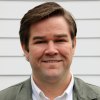

“I just kind of went into operational mode…”
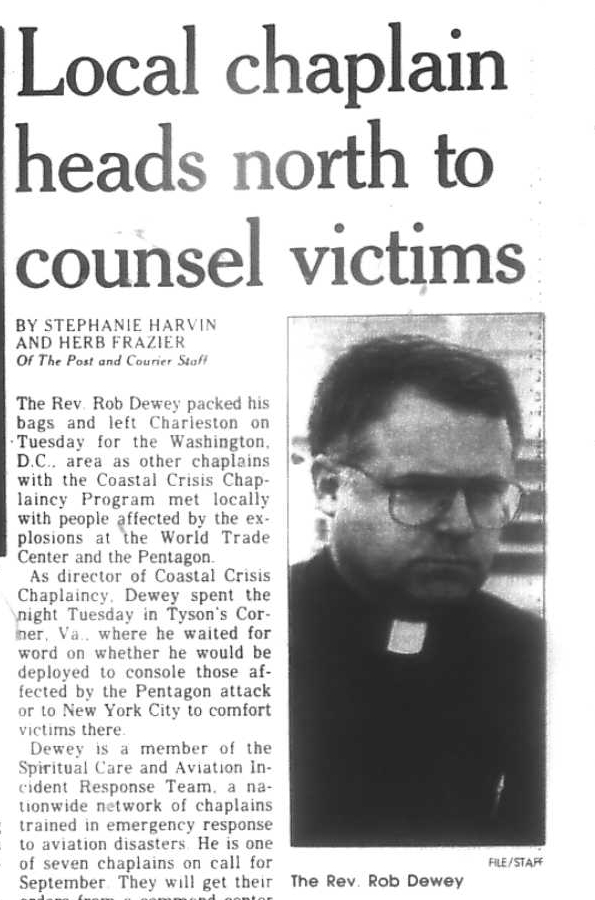
The Rev. Rob Dewey was one of the on-call chaplains for the National Transportation Safety Board for the month of September 2001. It was about 9:15 a.m. on the 11th when he was driving down Coleman Boulevard in Mount Pleasant and his phone rang. He was needed in Washington, D.C.
As an ordained Episcopal minister and founder of Coastal Crisis Chaplaincy in Charleston, Dewey routinely responded with emergency personnel to violent or traumatic events to counsel victims and loved ones.
After getting the OK from Sheriff Al Cannon to take his county-owned car on the nine-hour trip — all planes were grounded — he packed his bags and left for D.C. Once there, he was paged up to New York City, as the only chaplain with the Disaster Mortuary Operational Team [DMORT], a national team of fast-response forensic experts who help in mass-casualty events. As chaplain, Dewey provides moments of counsel for those in need of guidance or a sure hand.
Today, Dewey serves as chaplain for Lowcountry Community Chaplaincy, which he founded in 2017. He also works with people going through local drug court and people working in the food and beverage industry.
We caught up with Dewey on Friday to discuss his memories of spending two weeks in New York following the Sept. 11 attacks. The following is a transcript of that phone call, edited for content and clarity.
We got to New York City and we ended up at LaGuardia Airport, and we they set up a different morgue there … but they shut that down at about three days — the hanger wasn’t needed.
So I ended up being on the pile [at the World Trade Center]. I was at Freshkills, in Staten Island, where detectives are going through the debris. My ministry was mainly with my team members, 317 [DMORT] team members. But then I reached out some other people that just happened to show up. Some I ran into in the streets. Our team was working two shifts a day — 12-hour shifts.
I just kind of went into operational mode. I would come back to the hotel, and sometimes just take the uniform off that smelled like death, and put it in the corner, and then put on some regular clothes and go get something to eat real quick, and then come back and go to bed.
We call it a ministry of presence. A lot of times we don’t have something to say, but that we’re there, representing the Lord. And if they want a glass of water, we’ll get them a glass of water. If they want us to contact their minister or their rabbi, we will do that. We want to do whatever we can to help them.
All of [the days] run together, but one of them that I do remember is that I was right in the middle of ground zero night and had on my clergy collar. And I had a fireman come up to me and just say, “Father, please pray for my brother and my uncle, they’re down there somewhere.” And that wasn’t the time to go into theological discourse. That was the time for me to put my arm around him — even though he was much bigger than I was — I put my arm around him, and just did a quick prayer with him. He wouldn’t have stopped me if he didn’t want some spiritual attention.
When I got home back to Charleston, I just had a really hard time sleeping. So I ended up getting some counseling to help with that.
But then, the day that I got back, we had a little girl that was crossing the street for her bus in Berkeley County, and she was hit and killed by a car. What I said to the media, when I was being interviewed that day, I just said, “You know, for that family, that’s their 9/11 event.” And all of us have different 9/11 events. Some are smaller, and it doesn’t encompass the whole community. But this one, for New York City and the Pentagon, that certainly encompassed the United States and the world. So, I was honored to be there to be able to support.
Lowcounry Coastal Chaplaincy maintains a 24/7 answering service at (843) 720-9600 for those in need of a chaplain.

Help keep the City Paper free.
No paywalls.
No subscription cost.
Free delivery at 800 locations.
Help support independent journalism by donating today.