Ann Heymann has two commandments in her Gaelic music career: Thou shalt not compete with music, and thou shalt play with your friends when they ask.
Despite the first commandment, Heymann still entered the Granard Bicentenary Bun-Fhleadh Harp Festival in 1981 and 1982, winning first place both years.
Now, she will serve as the harp judge in this year’s Scottish Performing Arts Classic. With a history of competing, she approaches judging with a full understanding of what it’s like to perform both for a crowd and in front of competitors.
“If it’s a competition, they (attendees) look at a person up there, trying to play music, and they know it’s being judged,” Heymann said. “They’re thinking ‘is this considered good or not good?’ They listen with empathy to the performer.”
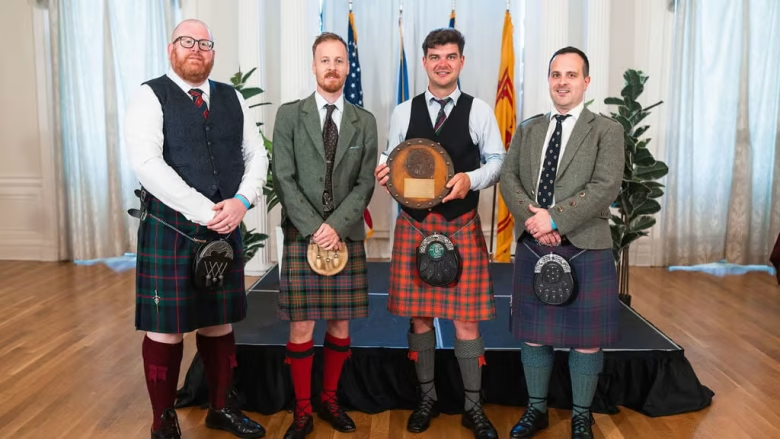
In partnership with the Robert Burns Society of Charleston, The Clan Donald Trust for the Gaelic Performing Arts is set to bring four Scottish prize competitions to the Piccolo Spoleto Festival.
The competitions will take place June 5-6 at the South Carolina Society Hall, with bagpipe events scheduled for June 5 and harp and fiddle competitions following on June 6.
A nonprofit organization, the Robert Burns Society of Charleston is dedicated to preserving and advancing Scottish American culture and heritage in the South Carolina Lowcountry and is now bringing the competition to Charleston for a sixth year.
Growing up in Scotland’s Orkney Islands, Louise Bichan has been playing the fiddle since age 7. Now, she is set to compete for the fiddle-playing prize. She said sharing Scottish musical history and culture allows traditions to continue as one generation passes them on to the next.
“Bringing this old, traditional music from Scotland as it might have been when the people first came over is kind of interesting in this modern day when things have moved, changed and the tradition has grown,” Bichan said.
A chance to compete
This year, four competitions will be held at the South Carolina Society Hall, 72 Meeting St., featuring instruments including the bagpipes, harp and fiddle. The first two competitions will focus on the bagpipes, followed by the harp and fiddle competitions.
All prizes are monetary awards of up to $2,500, and four competitors will perform in each category.
The first competition day features the Angus J. MacDonald Memorial Prize for Ceol Beag and the Joseph MacDonald Memorial Prize for Piobaireachd, both prestigious bagpiping awards.
The second competition day offers the Princess Margaret of the Isles Memorial Prize for Clarsach, a prize for harp playing. The Dan Rory MacDonald Memorial Prize for Scottish Fiddle offers an award for the best fiddle player.
JD Ingraham, music consultant for the competitions, has been a bagpiper for 25 years. He is responsible for identifying performers and judges from around the world to participate in the event. He said the overall experience of the competitions is what makes them so exciting to witness.
“It’s a fairly rare opportunity,” Ingraham said. “ I don’t think I had ever seen a harp in the flesh until I went to this event for the first time. You can YouTube anything, but to see somebody perform the harp live is really a different experience.”
Preserving Scottish culture
The competitions are deeply rooted in Gaelic culture, featuring instruments that date back hundreds of years in Scottish history. In early history, competitions relied on the patronage of Scottish nobles. Army bagpipers would get together, play tunes and see who is the best. Scottish nobles would sponsor an event and offer a cash prize to the best player.
Ingraham said the tradition grew beyond the British Army and Scotland, soon encompassing piping all around the world.
“I have seen fiddlers, but nobody quite as good as the ones that were invited,” he said. “It’s kind of like the difference between watching your local school band and getting to see somebody like Louis Armstrong.”
Bringing Gaelic culture to the Charleston area is central to Bruce Macdonald’s mission as chairman of the Clan Donald Trust and a board member of the Robert Burns Society. The organizations support Gaelic arts around the world and provide funding in countries including Canada, Scotland and the United States.
For Macdonald, he is extremely proud of what the competition is becoming.
“We want to keep the culture lively,” Macdonald said. “The music, the dance, the games and whatever else is necessary.”
IF YOU WANT TO GO:
The bagpipe competitions will take place on June 5 at 1:30 p.m. and 4:30 p.m. The harp and fiddle competitions will take place on June 6 at 1 p.m. and 4 p.m.
Tickets are $37 each or $63 for the full day bundle.
Madelyn Taylor is a magazine, news and digital journalism graduate of the S.I. Newhouse School of Public Communications at Syracuse University.

Help keep the City Paper free.
No paywalls.
No subscription cost.
Free delivery at 800 locations.
Help support independent journalism by donating today.